Learn DSADSAContests
coding75 logo
LeetCode POTDPOTDSheets
coding75 Pro
coding75 logo
Dashboard
Learn DSA
Course RoadmapFlow
DSA Topic TreeNew 🚀
Contest SolutionsPractice
Practice Sheets
MasterclassesLive 👨🏻‍💻

coding75 ProPRO

Live Classes & Placement Guidance

coding75 logo

The premier developer platform for mastering Data Structures & Algorithms, exploring contest editorials, building ATS-ready resumes, and accelerating your tech career.

Connect & Community

DSA & Contests

  • Learn DSA
  • Contest Solutions
  • LeetCode POTDDaily
  • Practice Sheets
  • MasterclassesSoon

Interview Prep

  • Portfolio Projects
  • CS Fundamentals
  • System DesignSoon
  • Interview ExperiencesSoon
  • Mock InterviewsSoon

Career & Pro

  • Jobs & Internships
  • Resume BuilderATS
  • coding75 Pro
  • Submit Feedback
© 2026coding75•crackDSA™•Maa Lalita Edtech Private Limited. All Rights Reserved.
Privacy PolicyTerms & ConditionsContact Support
Registered Office: Kanpur 208021•Regional Office: Indiranagar, Bangalore, 560008
Maa Lalita Edtech Private Limited
Contests/LeetCode/Biweekly Contest 136/3239. Minimum Number of Flips to Make Binary Grid Palindromic I
PrevNext
LeetCodeLeetCode
Medium
Biweekly Contest 136

3239. Minimum Number of Flips to Make Binary Grid Palindromic I

ArrayMatrixGreedy
Loading...
Solve on LeetCode

Problem Statement

Official algorithmic problem description and constraints.

Open on LeetCode

You are given an m x n binary matrix grid.

A row or column is considered palindromic if its values read the same forward and backward.

You can flip any number of cells in grid from 0 to 1, or from 1 to 0.

Return the minimum number of cells that need to be flipped to make either all rows palindromic or all columns palindromic.


Example 1:

Input: grid = [[1,0,0],[0,0,0],[0,0,1]]

Output: 2

Explanation:
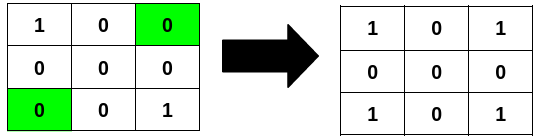
Flipping the highlighted cells makes all the rows palindromic.

Example 2:

Input: grid = [[0,1],[0,1],[0,0]]

Output: 1

Explanation:
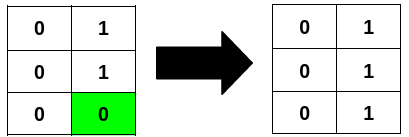
Flipping the highlighted cell makes all the columns palindromic.

Example 3:

Input: grid = [[1],[0]]

Output: 0

Explanation:

All rows are already palindromic.


Constraints:

  • m == grid.length
  • n == grid[i].length
  • 1 <= m * n <= 2 * 105
  • 0 <= grid[i][j] <= 1


Solutions & Walkthrough

Detailed video explanations, mathematical intuition, and clean C++ implementation code.

Connecting secure classroom stream...
Back to Biweekly Contest 136
Previous ProblemNext Problem